
Please go here to read the report, along with some commentary from yours truly.
thanks!
Geoff
Septics! Setbacks! Shoreline Vegetation!
Please go here to read the report, along with some commentary from yours truly.
thanks!
Geoff
Septics! Setbacks! Shoreline Vegetation!
Good morning, all.
There has been a lot in the news lately about Radon lung cancer deaths in Canada.
As you might know, I’ve addressed this subject on this site a few times. Please see:
Radon is the second leading cause of lung cancer after smoking. Radon is a daughter formed by the decay of Uranium, a naturally occurring phenomenon. Around Chandos, there is a lot of Uranium, and so Radon is something to be aware of.
If you only come to the lake during the summer, when your windows and doors are likely open a lot, you may not have as much risk as someone who lives here year round, and especially if one has a new build which is fairly tightly constructed.
Nevertheless, everyone should be aware of the radon situation in their own dwelling.
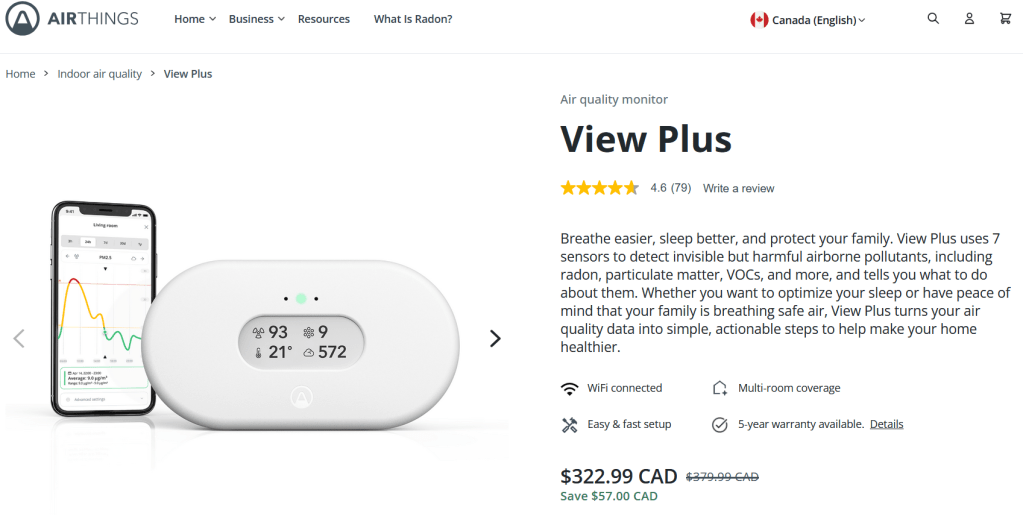
I have had several radon detectors, and so if you are considering purchasing one, I would suggest you might look at the Airthings View Plus Air Quality Monitor as I am very happy with mine. It costs about $400. Of course, there are others too that probably are just as good, so do a bit of your own research. Also some that are much cheaper.
Not only does the “View Plus” provide Radon readings, it also measure PM1 and PM2, CO2, VOC, Temperature, Pressure, and Humidity. Plus it can be hooked to wifi and monitored remotely. It is easy to use and has excellent graphs, etc.
.
Here is screen shot from my phone that just shows an overview at our place right now.
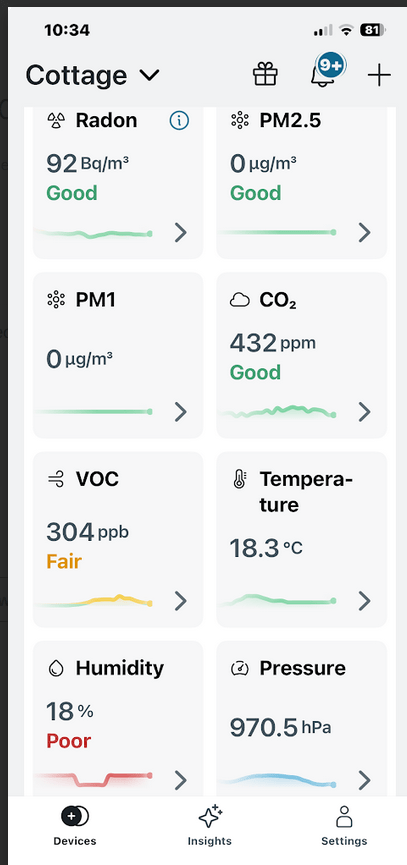
The VOC’s always give me a bit of a laugh.. As soon as our granddaughters get to the cottage with friends, the VOC’s really shoot up!
Hope everyone is surviving the wintry weather OK. I am waiting for a bit of break in the cold to go up and shovel off our deck!
There are always concerns about losing the propane supply when the temperatures get well below freezing. Hopefully these notes will help understand the situation a bit better in the cases of a closed propane tank feeding appliances such as a furnace, a water heater, a generator, or a BBQ.
It is pretty cold, and some folk may experience`issues with their appliances operating properly. However, if one has a decent sized tank and properly sized lines and a tank that is properly filled (not too much, not too little) then at temperature lows forecasted for Apsley for this week (Jan 23, 2026), all should be well. Please note that wind chill is not a consideration here, just the actual temperature of the propane.
The liquid resides in the bottom of the tank and the propane vapour resides above the liquid.
In a closed tank at a given temperature (warmer than -42degC) the gas and liquid remain in equilibrium, meaning that as many molecules of liquid convert to gas as gas molecules convert to liquid, and the pressure stays constant. This pressure is a function of the temperature.
As the temperature decreases two important things happen.
Things to minimize cold weather propane problems.
Happy New Year all!
The ice came to the main lake early this year, on December 30, 2025. It is not very often any more that this happens before the start of the new year. The snowmobilers should be happy!
An historical graph can be found at Chandossier.com here.
Keep safe! Keep warm! But get outside and enjoy our beautiful winters!
Geoff
Hi folks,
It has been a long time between posts……I hope everyone is doing well and that your days are are merry and bright……
The topic of low lake water levels is of strong interest these days. Of course, the main issue is the lack of precipitation, but the less obvious result of this is the drop in the water table, and its effect on the level of Chandos Lake.
A wee analysis and remarks about this issue can be found at:
Thanks to Debra Anthony, Iain Gorman, and Edith Gorman for input into this article.
It is snowing quite heavily in the Kawarthas today. That is good,,,,perhaps not for driving and shoveling, but certainly for helping to replenish the aquifer our lake depends on for input!
Best of the season
Geoff
As many visitors to this site know, there is a tab discussing the issue of Radon gas being a concern in the Canadian Shield. It is the number one cause of Lung Cancer after smoking, and anyone living on Chandos year round should be aware of the their Radon levels.
In Ontario, new builds are required by the 2024 Building Code, effective January 1, 2025, to include “radon rough-ins” with a subfloor depressurization system, protective soil gas barriers, and a sump pump with a sealed cover to prevent radon and soil gas ingress. These measures provide a system for easier installation of an active radon mitigation fan if future testing reveals unsafe radon levels, reducing risk in new homes.
Anyway, on my “walkabout” today I noticed some workers preparing a base for a concrete slab, and noted that they had installed piping to be used for Radon Mitigation if ever needed.
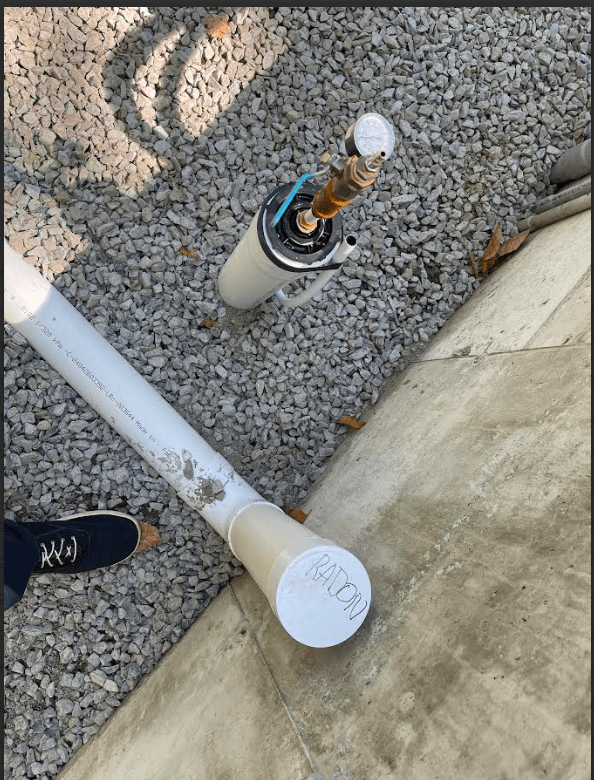
It involves installing a pipe during construction, a sealed sub-slab membrane, a granular drainage layer, and a capped pipe extending from the foundation to allow for the future installation of a fan-powered system if radon levels are found to be high.
(The thingy with the gauge beside it is preparation to pressure test water and septic lines prior to pouring concrete.)
Three cheers for our Chandos building construction community!
Well, if you’ll indulge me, I have a couple of things to beat the drums on.
The First is Water Bombers. Apparently during WWII Canada built 1 Lancaster bomber a day as part of its war effort. Let’s muster the same sort of urgency and commitment to fight our national forest fire threat!
It is certainly not my idea, but think of the job creation and fire defense capability we would have if there were a NATIONAL fleet of say, 500, water bombers that could be deployed anywhere in Canada. Currently we have about 4000 active fires, and I doubt if there are 75 water bombers in the entire country. Also, along with great jobs, what an incredible export market this would create.
Many fires are in remote locations and are very difficult to access on the ground. These planes could get there quicker, and safer, with less manpower and also be more effective. A water bomber, being able to fly low and slow, is also suitable for Search and Rescue.
I believe we do have a couple of Canadian Manufacturers, eg Bombardier and De Haviland, but they need supercharging in terms of production. We have the technology, but we need the national commitment!
The Second is Potable Water in Remote Communities. It seems a national disgrace that we have so many remote communities having to boil their water year after year after year.
I would like to see a nationally funded development of a modular water treatment plant that could be airlifted and assembled in any community with, say, more than 500 people, that has a sufficient water supply source that can be made potable by conventional means. These plants once installed, would be monitored and controlled remotely by a central command, likely one in each province and territory.
Our Engineering firms and Universities could be challenged (and rewarded) for engaging in a design competition for such a system.
Such an approach is currently being used with wind turbines, in that they are monitored and controlled by a central command that may not even be in the operating country.
Maybe there is something like this underway for Water Treatment Plants, but I am not aware of anything.
Please if you are free, come out and support this fire-preparedness initiative at Gilmour Bay Marina!
much thanks,
Geoff
Hello all,
The CLPOA Environment Committee is hosting a Fire Preparedness meeting at Gilmour Bay Marina on Sunday, July 6 at 10:00 am. Please see the complete agenda here.
2 different types of personal fire pumps will be demonstrated.
As well, The North Kawartha Fire and Rescue Service (NKFRS) will be in attendance to talk about the FireSmart program.
Glimour Bay Marina also has an Automated External Defibrillator (AED) on site, which is available for emergency use 24/7. NKFRS will also be demonstrating its use.
Come on out, learn a few things, and meet some of your like-minded neighbours!
Hi folks,
We are going to carry out another Fish Count Survey this summer.
Please click here to see more info.
The survey will be conducted from Thursday July 31 to Thursday Aug 7,2025. One of our aims this time around is to start focusing more on the species caught.
More promotion will occur in the coming days, but please talk it up with your fisher friends.
The situation with Lake Trout is becoming a concern.
Consider the following points:
I am wondering if we should launch a separate Lake Trout monitoring program that runs all year around. Getting participation is likely a huge obstacle, but we really need hard data to sense whether their numbers are in decline. Anyway, your thoughts on this matter are solicited.

 Chandos Lake Science 2